
Get To Know Your Stock: Yum! Brands
Have you ever ordered a Coke from a fast-food restaurant, only to be told, “Is Pepsi ok”? Then there’s a good chance you were standing in a Yum! Brands restaurant.
The reason for the menu restriction has its roots in the history of PepsiCo itself. From the late 1970s through the 90s, PepsiCo embarked on an acquisition spree: in 1977 the company entered the restaurant business with the purchase of Pizza Hut from co-founders Dan & Frank Carney. A year later, the company acquired Taco Bell directly from founder Glen Bell, and then in 1986 KFC was purchased from R.J. Reynolds.
Equipped with a triple-threat repertoire, PepsiCo rebranded its restaurant division as “Tricon Global Restaurants Inc,” and subsequently spun it off as its own corporate entity in 1997. In the years leading up to the new millennium, Tricon collaborated with Yorkshire Global Restaurants (the parent company of A&W), testing a multi-brand approach that you may have seen as combined A&W/KFC restaurants. The two companies found success with this experiment, and by 2002 Tricon and Yorkshire would merge, forming Yum! Brands. The newly christened company selected Louisville, Kentucky as its headquarters, just fifteen minutes down the street from KFC headquarters.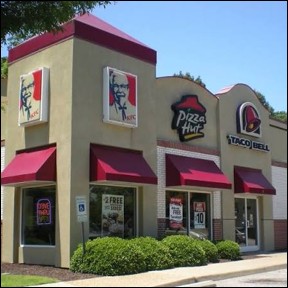
Shortly after the merger, restaurants owned by Yorkshire Global Restaurants began switching away from Coca-Cola products due to a lifetime perpetual agreement in Tricon’s contract to sell only PepsiCo products (“Sorry, we only have Pepsi!”). In another shift, Yum! Brands divested A&W, as well as Long John Silver’s in the early 2010s. Then in 2016, Yum! spun out its ownership of its Chinese brands, listing the new company under its own ticker. And just a few months ago, the company sold long-held Pizza Hut in a two-step process – part to Yum! China where the brand performs very well, and part to US investors.
Over the years, Yum! Brands has expanded globally to more than 63,000 restaurants in 155 countries supported by roughly 1,500 independent franchisees, including a few that are giants in their own right: KPB Brands owns 1,200 stores, including 831 KFCs and 162 Taco Bells; Devyani & Sapphire Foods operates 3,000 stores in India, Sri Lanka, Thailand, Nigeria, Nepal and the Maldives. So nearly anywhere you travel, you can enjoy fried chicken – just don’t expect it to come with a Coke!
As of August 2026
Diebold Dec-2012