
Market Musings Blog

Value Investing for Dummies

Last time we addressed value, we wrote about Penney. That’s a tough nut to crack, value-wise. Anything that’s losing money but will make money eventually is a tough valuation case.

This time, we’ll talk numbers, using a couple actual stocks that are much easier to value. We’re not going to get fancy here; we’re going to hit the high points, but be assured, this is the tip of the iceberg when it comes to actually valuing a company.

We’re going to start with IBM. This stock is selling at around 13 times its most recent earnings. That’s its PE (price divided by earnings). It means that we are paying $13 for every one dollar that the company has earned lately. In its history, IBM has typically sold at a PE between 11 and 20. Its recent history has been skewed to that 11 number because IBM has had earnings problems lately, but we do know IBM is capable of being valued by investors at a higher PE. Maybe it never gets to 20 ever again, but it might get to 17.

What happens if the company is valued at a higher PE and its earnings stay constant? Its price must rise. This is just a math equation: PofIBM/EofIBM = price/earningsIBM, so the way to make its P/E rise is to have something like (PofIBM+$10)/EofIBM.

If you have two things happen at once – slightly higher earnings and a higher PE, then the price rises more.

Aside from selling at a low PE relative to its history, IBM sells at a much lower PE than the rest of its competition, and the market as a whole. So it looks ‘cheap’ in this way, too.

So if we start with IBM selling near the lower end of its long term historical PE, and we are reasonably confident that IBM’s earnings can grow even very slightly, then the price of the stock will rise. Note! This is one of the beautiful things about value investing: you do not need for your company to perform miracles in order to get a return out of it. It doesn’t need to grow at 20% or 50% – of course if it does, you will have a bonanza. But since we are buying so cheap, all we need is for IBM to grow just a little tiny bit – not a big hurdle.

What about other measures? Well, IBM’s dividend yield is much higher than most stocks, at 3.5%. That’s even higher than the long term Treasury. It’s 160% of the rate of the average stock in the S&P 500. Its return on capital is about 20%. That’s really high. Anyone should be happy to garner a 20% return on his capital.

So we can conclude that IBM is cheap, and might be worth an investment.

Now we will look at Netflix. Its PE is 330. That means we are paying $330 for every $1 the company is earning. That is a lot more to pay than IBM’s shares would cost. Netflix has no dividend. Its return on capital is about 5%. None of these measures make Netflix look like a good value. In every way, investors are paying more for this stock.

Netflix may be a growth manager’s cup of tea, but it does not work for us. The mathematical expectation that is required to justify Netflix’ share price is unreasonable: growing into this PE means Netflix must grow much faster than it has in the past. The problem with requiring a higher growth rate to justify a stock price is that you cannot know this will pan out, and if it doesn’t, the stock will crater. This may be dawning on investors because the stock price today is selling at the same price that it was selling at back in August of 2015. It has gone nowhere since then – 16 months. Meanwhile, the market is up over 8% since then. Netflix is being left in the dust.

IBM, however, does not require a stretch of the imagination, mathematical unreasonableness, or any other contortion to see that its price will probably rise over time.
America’s Own ‘Brexit’

Last night’s historic electoral upset (not the first for the US, but surprising all the same) is still in the digestion phase, and will be for some time. Markets, however, wasted no time adjusting to the new reality, at least what we know of it now. After a two day run that tacked 450 points onto the Dow leading up to last night, the overnight action took Dow futures down some 800 points on bourses overseas. It’s a good thing folks in the U.S. didn’t have the opportunity to trade, however, since by morning, traders were already changing their minds, allowing the Dow to open nearly flat. As we write this, the prospect of less regulation, a tax policy overhaul, and other measures are causing stocks to rally strongly. Time will tell if these things come to pass, and even if they do, how they will affect individual companies, but certain things remain true:

Valuation still drives returns. Factors that no politician can control – demographics, indebtedness, and pension liabilities – are driving interest rates down. Earnings still matter. Humans still prefer improvement over decline. None of these things has changed. The background of a decent, if not ebullient, economy, low interest rates, equity valuations that are not out of sight, and this earnings season, the first quarter in six, when earnings actually appear to be increasing, are the factors that drive stock prices over time.

Our job is to filter the noise, particularly that proffered by the media; to understand that companies adjust – they do not remain static like the proverbial deer in the headlights awaiting slaughter by oncoming negatives; and that, consequently, things generally improve over time after individual companies experience misfortune. It is these factors – along with client circumstances and risk management – that lead to buy and sell decisions. We may not know how the new president will govern, but we do know a lot about this craft we practice, and that’s our focus.

What We See vs What’s Real

I recently visited downtown Chicago. The city is spiffy, cheerful, and on the weekend I was there, events were abundant, the restaurants were crowded, cranes were sprinkled around town even with workers on overtime setting windows on a Saturday. Compared to the other big city I am in often – New York – Chicago shone. New York’s dark narrow streets, litter, and general bedlam make it seem like a third world country sometimes.

However, in terms of financial health, NYC far outperforms Chicago. Chicago is now junk rated by Moody’s and barely investment grade over at Standard & Poor’s, with a negative outlook at both. NYC is high investment grade, so far out of Chicago’s league that it’s not even comparable. Chicago’s schools, pensions, and city services are suffering on a scale rarely seen in the U.S. Crime is up substantially as at-risk populations feel the pinch.

This is a microcosm of so many things in life, where we see one thing, but the reality is different. Fish populations are plunging, but when humans look out at the endless ocean and then see vast arrays of fish at the fish market, we think everything is fine. We see cranes in the sky in many cities now, and housing prices rising, and unemployment falling, but those bits of evidence belie the huge debt we have accumulated in the last few years. Our national debt has risen from roughly $10 trillion eight years ago, to $20 trillion now. Should interest rates rise even a little, we will find that much of our national budget must be used to pay interest, crowding out social services of all kinds. That’s a sickness for which there is no fast cure, and every one of us will feel the consequences. We already have one of the slowest recoveries on record partly due to our fiscal situation, but in the future we will notice our deficit more acutely. Most notably, the next President will be have very limited room to maneuver, economically, no matter which party comes to power. Yet this is a problem which many argue is not a problem at all, completely contradicting math, which we all learned in grade school.

We don’t generally delve very deeply behind headlines or what our eyes show us, but we must begin to, as we forge ahead to solve today’s problems.

How Value Investing Works, Part I

This post is dedicated to a couple clients – you know who you are! – who requested a sort of primer on value investing. Sorry it’s so tardy, but you know, better late than never.

In an era when indexing has captivated the investing public, it seems anachronistic to be writing about actually thinking about what to invest in. After all, indexing is the ultimate ‘black hole’ for knowledge. You don’t need to know a thing, think a thing, evaluate a number, understand a financial statement, or talk to management – all you do is buy the index, which is a bunch of stocks that are the largest companies around. Are these companies in the index because they are good companies? Not always. JC Penney, a stalwart of the S&P for decades, was kicked out in 2013, in favor of a slightly larger company. It was kicked out because it ran into trouble, but it has started to recover, and now it’s actually larger than the smallest S&P companies so in a twist of irony, it might get let back in. What does all this have to do with whether JC Penney will make money for you? Absolutely nothing.

But JC Penney does offer an interesting illustration of value investing. JC Penney is Value Investing: Graduate Course, prerequisite Value Investing For Dummies. In other words, JC Penney is a tough call. It’s easy to say that banks are cheap value stocks right now, with bank bashing happening all over the place, Deutsche Bank in dire straits, and Wells Fargo in front of Congress every two minutes. This scrutiny has shoved bank prices down down down, while their earnings are really not bad thank you very much. Dividends are pretty fancy too. When stock prices fall because of a perceived problem, but fundamentals remain …. well, at least okay if not sterling, then you probably have a good value on your hands.

JC Penney is worse off than 99% of banks out there. Fundamentals are really not very good at all. In fact, Penney was given up for nearly dead, especially by the ratings agencies for its bonds which had them rated a whisker above D for DEFAULT. Penney has lost money, scads of it, for a few years now. It’s had at least a couple CEOs in just a few years. But, and here’s where thinking comes in, it has found religion, and is scrambling to improve, and it has taken tacks that are worthwhile given the retailing environment. It has begun to pay down debt, and earned an upgrade from one ratings agency at least. It is losing less money. Cash flow has been positive for some time. Its results whomped Sears, Nordstrom, Macy’s, and others in the last couple quarters. It is actually growing.

The stock, however, is in the $9 – $10 area. Ok, it’s recovered from the bottom, and it’s probably outrun the improvement that’s becoming evident – we call that ‘overextended’. No doubt one would rather pay $8 than $10. Question is, will you get a chance at $8 before it goes to $12?

Value managers try not to forecast, mostly because no one is any good at it over time. So our job is to determine if paying $10 for Penney brings us enough value to make the price worth it, today. Not two years from now, because we can’t know that. But we do know that if we pay a cheap enough price for an asset – and that’s what Penney is, an asset – it will be a lot easier to make money than if we pay a lot for an asset.

Next time, we’ll get into numbers a bit, to show what ‘cheap’ really means. Stay tuned!

The Fed’s Method

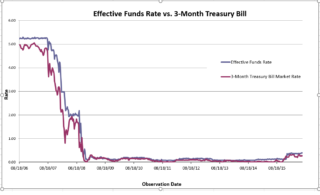
For years, we have observed that the vaunted Fed has, at serious inflection points, done nothing more than followed the market. The evidence we’ve collected shows our hunch is on the mark, and that the market generally ‘knows’ ahead of the Fed where rates ought to be, even in the shortest maturities. Of course, there’s something to the ‘jawboning’ theory – the Fed talks a lot before changing rates so the market has a chance to adjust. Still, take a look at the chart below:

FedGraph

In the critical 2007/08 time frame, a wide gap appears between policy rates and the market. During this time, officials felt that the economy would withstand the decline in real estate prices, and they stubbornly refused to make an adjustment despite falling rates in the bill market which were all but screaming ‘warning!’ Then, as it began to dawn on officials that things could get ugly, policy rates were lowered, but not quickly enough.

In this era of sharp criticism aimed toward the Fed, we note that its meddling in matters of the economy have not always worked. As interest rates head to negative territory all over the world, the US is likely not far behind, and this tidal wave will drown Fed policy. Managing bond portfolios is best done with ears tuned to the market itself, rather than the Fed’s words. The yield curve and yield differentials are excellent communicators; ofttimes, the Fed is just noise.