
Market Musings Blog

The Conventional Wisdom About Brexit is Wrong

The media is full of disaster mongering now that Brexit has passed, In fact, even some Brits have been horrified by their own behavior in the referendum and are wishing they could take it back.

The conventional wisdom is that Brexit will be a disaster for economies. Depending on whose publication you are reading, this ranges from Britain’s economy to the EU (those who remain), to the world (see The Economist), to corporations if one can stretch to believe a company can be an economy (in miniature I’m sure). But economists have a spectacular record – of incorrect calls. In fact, on big items like Brexit, it is a rare economist who gets it right. We were particularly annoyed to hear Alan Greenspan – who really ought to crawl in a hole and never come out – predict doom and gloom. Frankly, hearing him issue a negative prediction is almost enough on its own to make me believe the opposite.

It may be that economies hesitate for a bit while the effects of the vote sink in. But it’s going to be hard to tell whether any of those effects are due to Brexit, or something else. Let’s not forget that some were predicting a slowdown in Britain before Brexit. In the US, the labor market is flashing a warning, and spending at restaurants – which has been robust – is slowing. Our election environment is partially to blame for softness on these shores. In the EU, slow has been the operative word for years now.

So before believing the dire scenarios pumped by the media, engage in a bit of watchful waiting and remember that in fact, most of the world is not part of the EU, and many of those economies are performing at least as well as the EU.
Brexit? But I’m Not British!

Tonight Britain has passed a referendum calling for the country to leave the Eurozone. It looks like US markets will open down severely tomorrow. The British pound is down about 10% against the dollar, and Asian markets are sinking fast. So no question about it: we’re in for a roller coaster ride for a while.

Aside from short term market reactions, why should US citizens care about Brexit? We posit a few reasons:

  1. That the Brexit vote resulted in ‘leave’ and voter turnout was so strong, indicates that a revolution of sorts is under way. A rather large percentage of people are pretty tired of not feeling heard, all over the world. Policies will have to change, which will usher in even more uncertainty than we’ve already seen this decade.
  2. The success of Brexit may have an effect on our own fast-approaching election, or at least policies we pursue around immigration, trade, and so forth.
  3. After Brexit, it’s a certainty that we will see other European countries contriving their own versions of ‘exit’. How strange that a few years ago we all worried that Greece might be forced to leave (Grexit), and now we have a country that has chosen to leave.
  4. Well, ok, we can’t resist mentioning – if you ever wanted to visit England, now’s the time. It’s going to be cheaper!

Consequences of these shifting policies will reverberate to returns over time. We can’t possibly predict even the direction of the impact yet. For the time being, we view the ‘leave’ vote as a shot at buying assets at cheaper prices.

Finally, if you want to know why Brexit was entirely predictable, pick up a copy of The Revenge of Geography, by Robert D. Kaplan (reviewed on our Resources page here). Uncanny!

Whither Interest Rates?

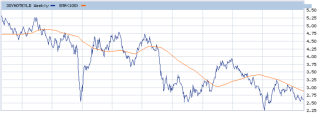
While pundits have claimed that there is just no more money to be made in bonds because rates are as low as they’ll go, rates keep dropping ever lower. Take the thirty year Treasury issue. In 2008, at the height of the Great Recession, the yield on this bond shattered US records by plunging to 2.50%. A rebound followed all the way up to 4.75%, only to see the bond revisit 2.50% again in mid 2012. Once again, there was a rebound, but weaker – to just shy of 4%. Then, in early 2015, the bond dropped all the way to 2.25%, breaking its old record. In fact, we saw the yield at 2.12% intraday back then. The ensuing rebound carried the yield to just 3.25%, well below the last high. Here’s what this progression looks like:

30Yr

The economic circumstances that have led to the decline in yields are too complicated for this post, but suffice to say, they haven’t changed. The primary factor has been rising indebtedness here, in Europe, in China, in the oil patch, in public budgets, everywhere really – and that’s become worse, not better.

A colleague asked the other day, where do you think rates go from here? There we were, on the day of his question, in the lull of slightly under 3% on the long bond, and I didn’t really know what to say. We’ve been bullish on bonds for what seems like forever. Was that still justified?

Standing back, now, and looking at this trend which clearly shows lower highs and lower lows, and considering the pending bankruptcy of Puerto Rico, the continuing saga of Greece, the problems in Illinois, Atlantic City, and Hartford, and the patches applied in several California municipalities which will, sooner or later, come loose again – nothing has changed. In fact, things are worse – China has learned our bad habits and estimates say its debt exceeds 300% of GDP now, up tremendously from a very reasonable rate just a few years ago. Worse, defaults are rising. We all know China can rock the rest of the world.

Combine this with the fact that many other slow growth countries are experiencing negative interest rates. For a mind bender, consider that in Norway, some mortgage holders are getting checks from their lenders – rather than paying the bank for the house, the bank is paying them to own the house.

Those negative interest rates make our positive rates look mighty attractive, even at 2%. If buyers continue crossing borders to suck up our Treasury issuance, that will pressure yields downward still more.

My bet, then, is we head lower yet. You may one day have a shot at refinancing your home loan at 2%.


Revenge of the Nerds

The market has taken a turn lately. The ‘in crowd’ – those golden stocks of last year, including Netflix, Amazon, Google (okay, okay, “Alphabet”) – are flunking out. Despite fancy earnings at Netflix and Google (Amazon hasn’t reported yet), the stocks fell sharply during their reports. These high fliers are all down for the year. Facebook is – thus far – an exception, up a few points; it hasn’t reported yet either.

Meanwhile, industrial companies are pulling out all the stops, and have been for several quarters now, managing their way through a strong dollar, emerging markets disruptions, bond market sell-offs, slow economies, the crash in oil prices, increased regulation …. you get the picture. Their efforts are finally being rewarded. Earnings are not necessarily good yet, but the big downdrafts have ceased, or everyone has become used to the negative scenarios, and these stocks are trading up, rather than down, despite some disappointments. This is the juncture we were waiting for – when investors shift from ‘bad news is bad, and good news is bad’ to ‘bad news is good, and good news is good’. It’s a time when so-so results are viewed as ‘well, it’s not as bad as it could be’. Even the banks, which were pariahs just a week ago, seem cast with a rosy glow.

The nerds deserve a day in the sun, after last year’s beating.

How to Win at Stocks

There are three ways to generate extraordinary returns from stocks. You don’t need a degree in finance, or tons of experience to practice these methods. Like doing anything well, you do need diligence and discipline. Beyond that, time is the only necessary ingredient.

  1. Follow and learn about a company that no one else follows, to gain an information advantage. Thousands of listed stocks are available, and 99% of these are vying for your attention. Some, like General Electric, attract hundreds of analysts. It’s hard to know anything about GE that other people don’t know. But among smaller companies, information is scarcer – buried in SEC filings, or locked up in the CFO’s mind, even in footnotes to annual reports. Reading about a company you never heard of might bring a diamond to light.
  2. Look at the information everyone else ‘knows’ in a different way. Take IBM. Everyone knows it has a legacy business that is sliding; that it is in a turnaround; that the turnaround will take a long time; that it may not work. The market has been obsessed with these negatives. But also in the company’s reports are indications that its cloud computing business is growing fast. We’ve recently seen reports of the company’s efforts to gain contracts overseas with telecom companies; it may be just a matter of time before it is able to sign a major-ish contract with a US telco. Focusing on the positive, instead of the negative, might lead to a different conclusion about IBM’s stock.
  3. Behave differently, related to #2 above. A great example of behaving differently was buying corporate bonds in 2008 and 2009 instead of selling them. Back then, Nordstrom’s bonds yielded close to 11%. IBM bonds were near double digits. The carnage was spectacular. Everyone and his brother was selling. Behaving differently – buying instead of selling – made a lot of money. In nearly every market, there is an opportunity to behave differently. Right now, energy stocks present that opportunity.